Operators urged to focus on fundamentals as scaling pressure mounts
Everything else is just noise, according to one QSR brand leader.
Quick-service restaurant operators are being urged to cut through external market noise and refocus on product quality, customer experience and disciplined execution as they navigate increasingly complex scaling challenges.
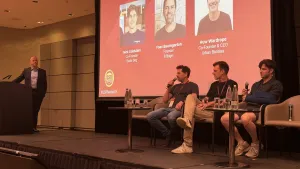
Speaking on the Leaders Panel at the QSR Media UK Redcat Conference & Awards 2026, UK QSR brand executives said that whilst trends such as changing customer behaviour, aggregator growth and shifting value perceptions are important, they do not outweigh the fundamentals of running a viable restaurant business.
Jon Lake, Managing Director, Chopstix said operators risk being distracted by short-term industry themes if they lose sight of core execution.
“I think everything else is noise. I think it's just about staying on top of product quality and customer experience in whatever form that comes,” Lake said. He added that the starting point for any operator should remain the same, regardless of channel shift or format evolution.
“It comes down to, you know, what is it you're giving the customer? Is it good quality? Is it what they want? Is it convenient?”
The panel also highlighted that scaling introduces structural challenges, particularly around consistency, culture and systems.
Aoife Dannatt, Managing Director, Chipotle Europe, said maintaining standards becomes significantly harder as brands expand.
“Consistency becomes exponentially harder when you scale. When you're small you have control and you can quickly make a business impact,” she said.
She added that growth must be managed carefully to avoid diluting brand standards. “It's easy to talk about opening restaurants. It's much harder to scale a brand intentionally while keeping your brand standards intact.”
Khalil Rehman, Co-Founder, Director, Caprinos Pizza, also pointed to shifting customer behaviour and increased competition, noting that customers are more selective with spending and that brands must continually evolve their offer.
Rehman said winning products no longer guarantee sustained success. “You could have a winning product in the past, which have done really well, but that doesn't give you a guarantee that it will carry on being the winning product,” he said.
He added that brands must continuously adapt to changing expectations and ensure customers understand the value proposition behind their spend.
On scaling risks, operators pointed to the difficulty of maintaining control beyond early-stage growth, with consistency and supply chain discipline emerging as key constraints.
Panelists agreed that internal systems, training and culture become increasingly important as businesses expand, particularly as reliance on technology and third-party platforms increases.
The panel also highlighted aggregator platforms as a structural challenge, particularly around customer ownership and data access, with brands seeking to rebuild direct relationships through owned channels.
On performance metrics, executives agreed there is no single measure of health, with a combination of same-store transactions, unit economics, customer satisfaction and return on capital seen as more meaningful indicators than headline sales growth alone.
Lake said operators need to look beyond surface-level metrics. “I think for us it's probably about about measuring the same store transactions, it's probably about whatever customer metric is your most relevant one, whether that's MPs, whether that's Google, whether that's, and your likelihood of appealing to people, and then ultimately return on capital.”
The discussion also returned repeatedly to value, with executives defining it not simply as price, but as the overall customer experience, including speed, quality and perception of fairness.
Dannatt summed up the sentiment by reframing value as a holistic experience. “Was it worth my money, was it worth my time.”
Dannatt advised that the biggest mistake QSR brands could make today is to grow restaurants just for the sake of it.
“Culture is really important there. So really making sure that you have the necessary, the right people that are going to protect that culture, the right processes that are going to scale that culture,” Dannatt said.
Rehman said focusing too much on technology and underestimating the importance of people could be fatal mistake.
“You're expanding, so you need to have those leaders, those mindsets to move your brand forward. So it's really important to have the same attention to develop the team and leaders within your business,” Rehman said.
Lake said that at Chopstix, they practice the 7, 17, 70 rule where you change how you do things at each milestone.
“I think the discipline around making sure that your organisational structure is designed to deliver that strategy in terms of that market that you own, I think that's key as well,” Lake added.